#install.packages("pak")
pak::pak("yukiyanai/rgamer")An Introduction to rgamer
Examples for useR! 2026 in Warsaw
Preparation
Install rgamer (if necessary).
Load rgamer.
library(rgamer)Normal-form games
Example 1: Prisoners’ dilemma (Not shown in the poster)
Define a normal-form game with normal_form().
game1 <- normal_form(
  players = c("Kamijo", "Yanai"),
  s1 = c("Stays silent", "Betrays"),
  s2 = c("Stays silent", "Betrays"),
  payoffs1 = c(-1,  0, -3, -2),
  payoffs2 = c(-1, -3,  0, -2))
Find solutions of the game using solve_nfg().
sol_g1 <- solve_nfg(game1)Pure-strategy NE: [Betrays, Betrays]|
Yanai
|
|||
|---|---|---|---|
| strategy | Stays silent | Betrays | |
| Kamijo | Stays silent | -1, -1 | -3, 0^ |
| Betrays | 0^, -3 | -2^, -2^ | |
Example 2: Stag hunt
Define a normal-form game with normal_form()
game2 <- normal_form(
  players = c("Kamijo", "Yanai"),
  s1 = c("Stag", "Hare"),
  s2 = c("Stag", "Hare"),
  payoffs1 = c(10, 8, 0, 7),
  payoffs2 = c(10, 0, 8, 7))
Find solutions including mixed-strategy Nash equilibria using solve_nfg() with mixed = TRUE.
sol_g2 <- solve_nfg(game2, mixed = TRUE)Pure-strategy NE: [Stag, Stag], [Hare, Hare]Mixed-strategy NE: [(7/9, 2/9), (7/9, 2/9)]The obtained mixed-strategy NE might be only a part of the solutions.Please examine br_plot (best response plot) carefully.|
Yanai
|
|||
|---|---|---|---|
| strategy | Stag | Hare | |
| Kamijo | Stag | 10^, 10^ | 0, 8 |
| Hare | 8, 0 | 7^, 7^ | |
Examine the best-response plot (br_plot)
sol_g2$br_plot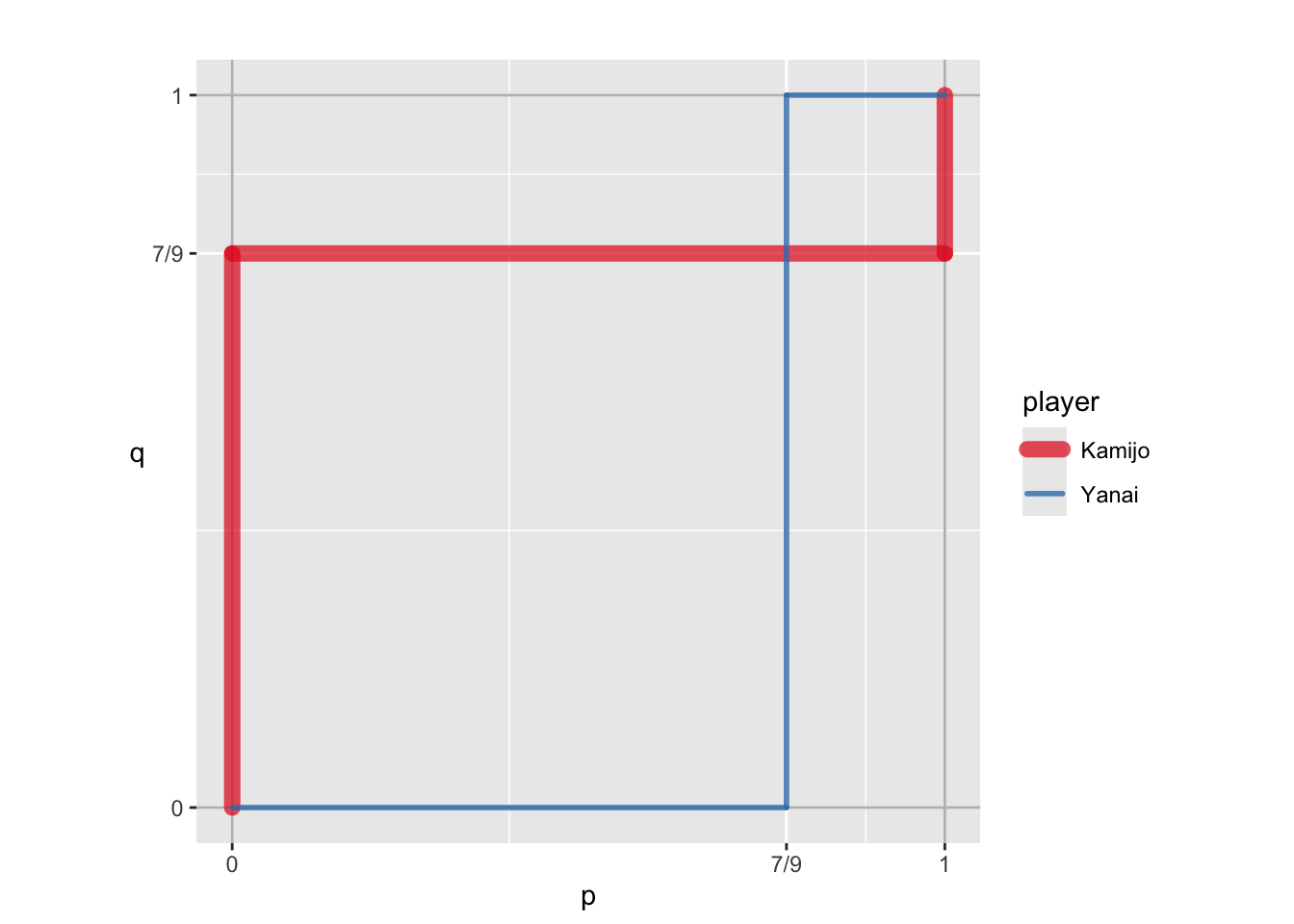
The plot shows that there are three intersections of the two correspondences: two pure-strategy NEs, (Stag, Stag) and (Hare, Hare), and a mixed-strategy NE, ((7/9, 2/9), (7/9, 2/9)).
Example 3: Cournot competition
Define a game of which payoffs are given by functions.
game3 <- normal_form(
  players = c("Firm 1", "Firm 2"),
  pars = c("x1", "x2"),
  par1_lim = c(0, 30),
  par2_lim = c(0, 30),
  payoffs1 = "x1 * (20 - x1 - x2)",
  payoffs2 = "x2 * (16 - x1 - x2)"
)
Find solutions of the game.
sol_g3 <- solve_nfg(game3, plot = FALSE)approximated NE: (8, 4)The obtained NE might be only a part of the solutions.
Please examine br_plot (best response plot) carefully.Show the best-response plot with NE marked.
sol_g3$br_plot_NE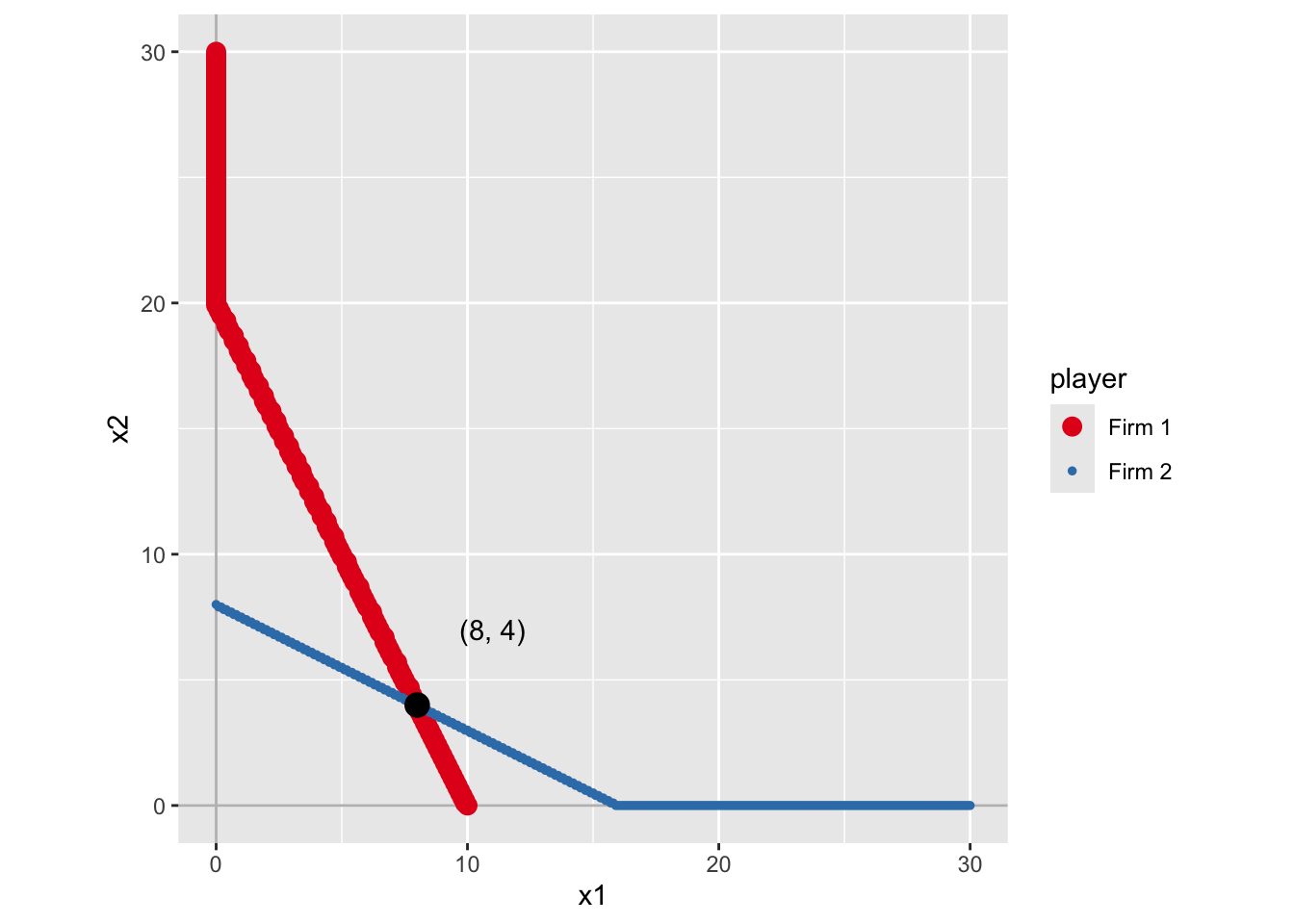
Extensive-form games
Example 4: Price competition
Define an extensive-form game with extensive_form().
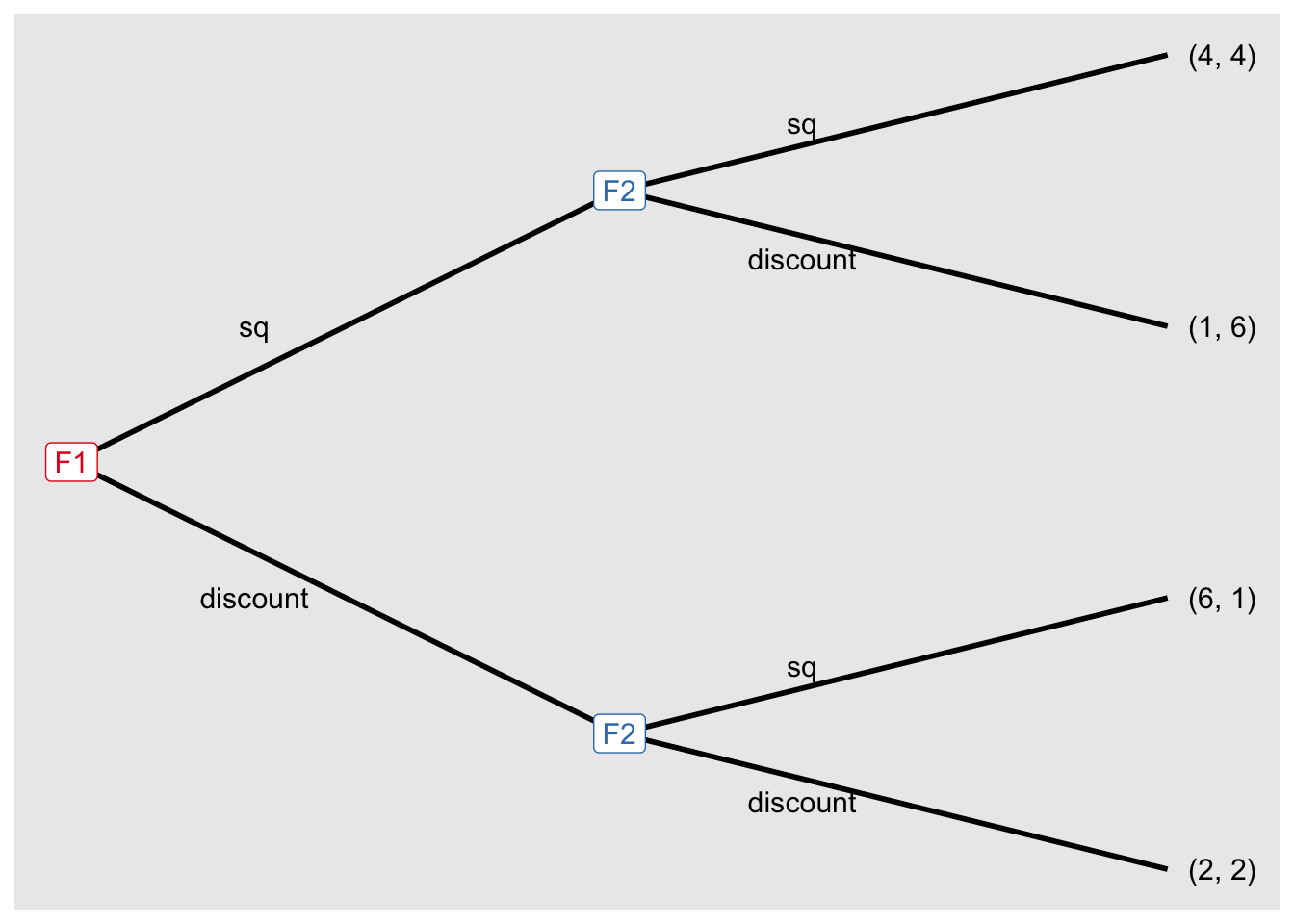
game4 <- extensive_form(
  players = list("F1",
                 rep("F2", 2),
                 rep(NA, 4)),
  actions = list(c("sq", "discount"),
                 c("sq", "discount"), c("sq", "discount")),
  payoffs = list(F1 = c(4, 1, 6, 2),
                 F2 = c(4, 6, 1, 2)),
  show_node_id = FALSE,
  direction = "right"
)
Find solutions of the game by backward induction using solve_efg().
sol_g4 <- solve_efg(game4)backward induction: [(discount), (discount, discount)]Show the tree.
sol_g4$trees[[1]]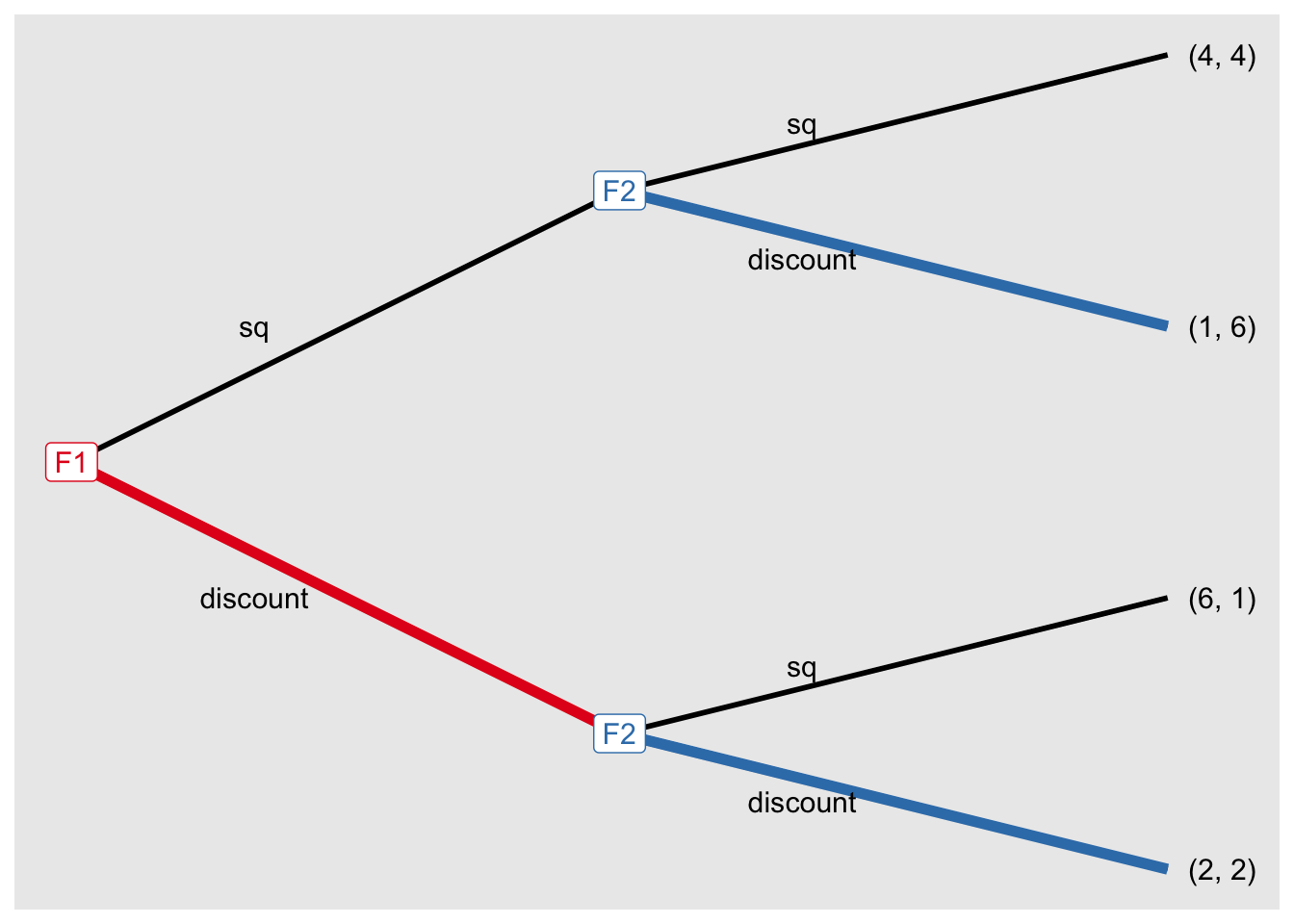
Two-player extensive-form games can be transformed into a normal-form game by to_matrix()
g4nf <- to_matrix(game4)Since g4nf is a normal-form game, you can find NEs using solve_nfg().
sol_g4nf <- solve_nfg(g4nf)Pure-strategy NE: [(discount), (discount, discount)]|
F2
|
|||||
|---|---|---|---|---|---|
| strategy | (sq, sq) | (sq, discount) | (discount, sq) | (discount, discount) | |
| F1 | (sq) | 4, 4 | 4^, 4 | 1, 6^ | 1, 6^ |
| (discount) | 6^, 1 | 2, 2^ | 6^, 1 | 2^, 2^ | |
Example 5: Ultimatum game with the entrance stage
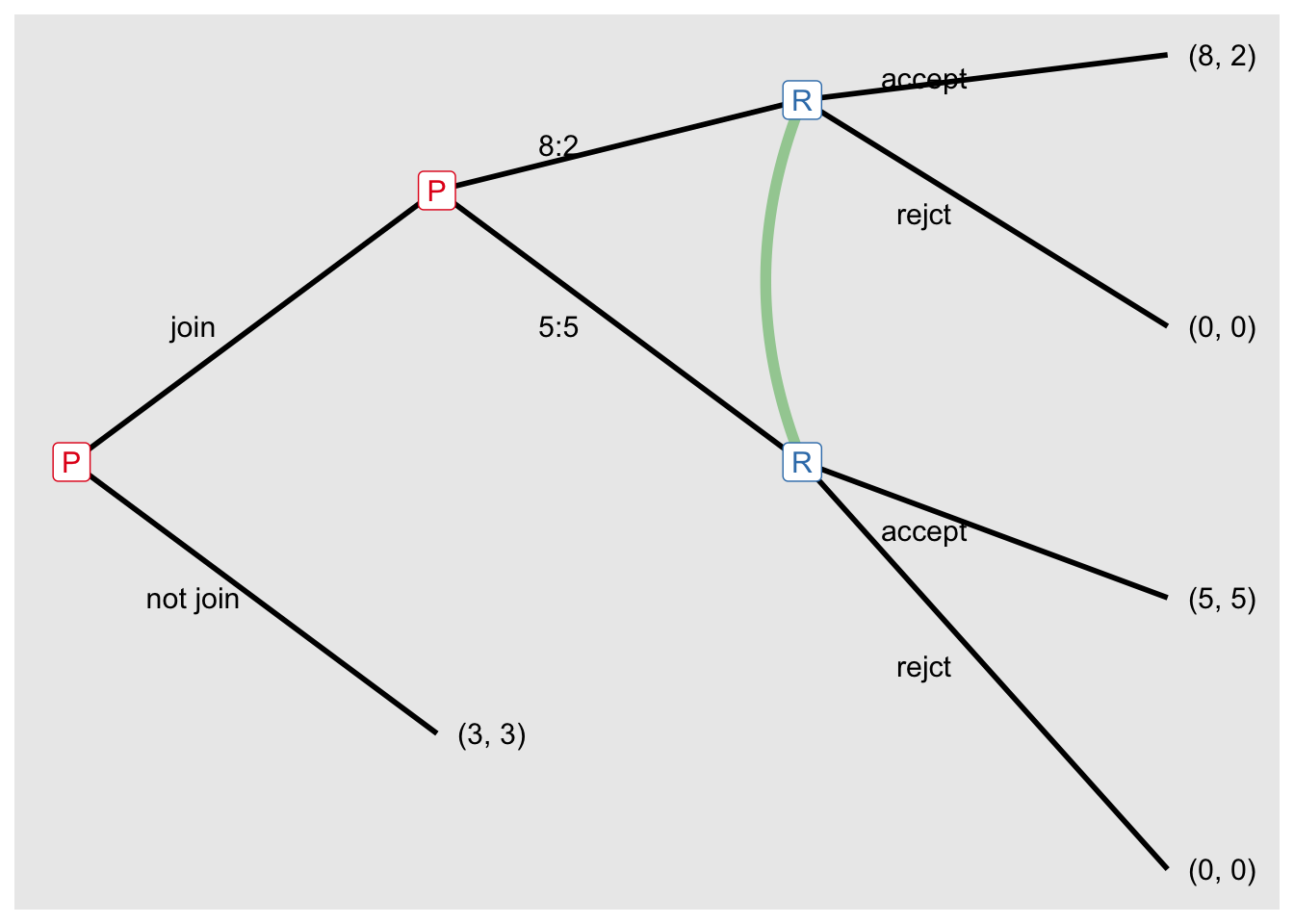
Define an extensive-form game of imperfect information with extensive_form(), where you must specify info_set.
game5 <- extensive_form(
  players = list("P",
                 c("P", NA),
                 rep("R", 2),
                 rep(NA, 4)),
  actions = list(c("join", "not join"),
                 c("8:2", "5:5"),
                 c("accept", "rejct"),
                 c("accept", "rejct")),
  payoffs = list(P = c(3, 8, 0, 5, 0),
                 R = c(3, 2, 0, 5, 0)),
  info_sets = list(c(4, 5)),
  direction = "right",
  show_node_id = FALSE
)
Find sub-game perfect equilibria with solve_eft() with concept = "spe".
sol_g5 <- solve_efg(game5, concept = "spe")SPE: [(join, 8:2), (accept)]Show the tree
sol_g5$tree[[1]]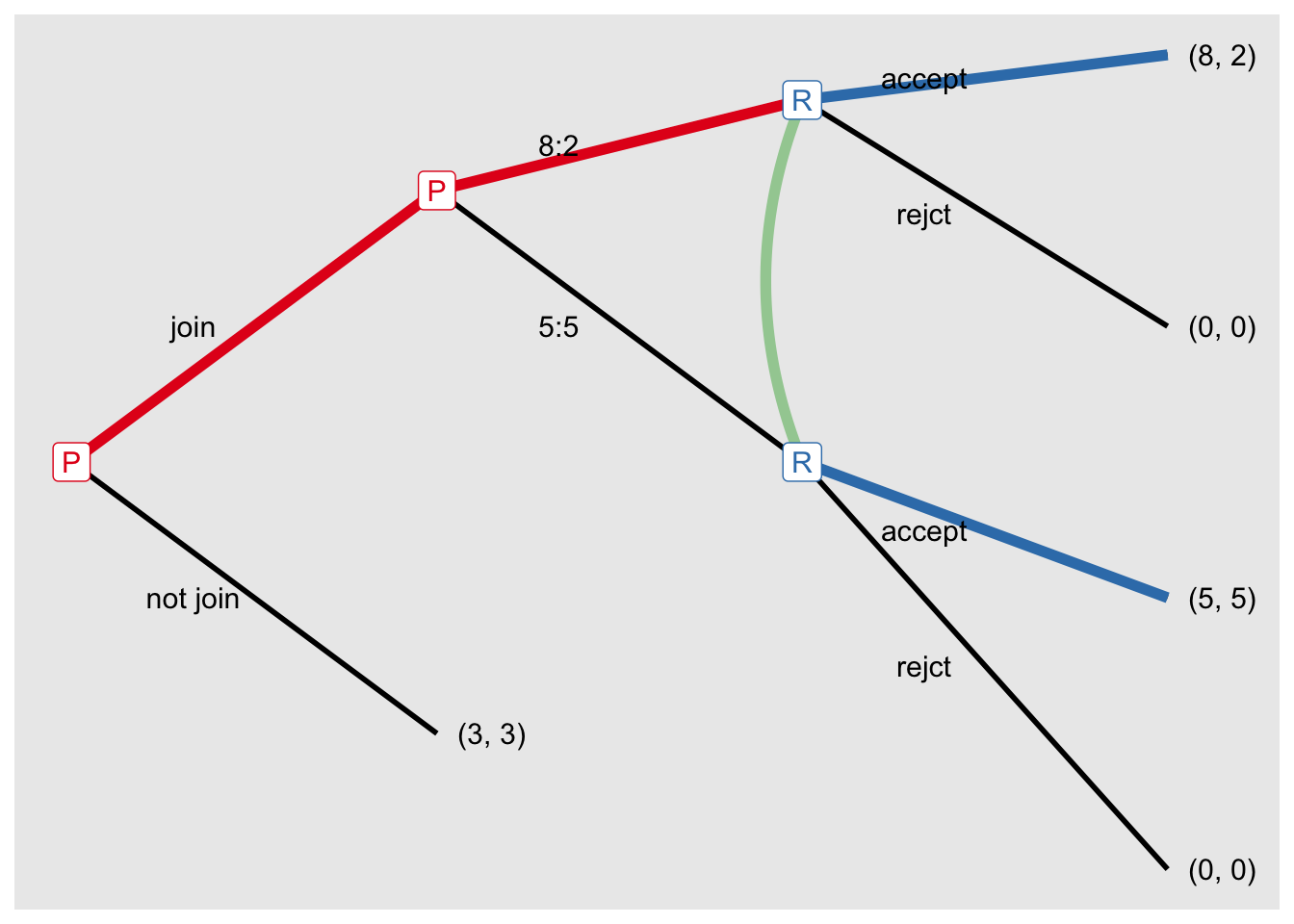
Simulating learning processes
Example 6: Reinforcement learning in Cournot competition
Define a Cournot competition with discretized payoffs.
game6 <- normal_form(
  players = c("Firm 1", "Firm 2"),
  pars = c("x1", "x2"),
  par1_lim = c(0, 24),
  par2_lim = c(0, 12),
  payoffs1 = "(20 - x1 - x2) * x1",
  payoffs2 = "(16 - x1 - x2) * x2",
  discretize = TRUE,
  discrete_points = c(4, 4)
)
Simulate reinforcement learning with sim_learning() with type = "reinforcement".
set.seed(2026-06-04)

g6_reinf <- sim_learning(game6,
                         n_samples = 100,
                         n_periods = 30,
                         type = "reinforcement",
                         lambda = 0.1,
                         plot_range_y = c(0, 1))
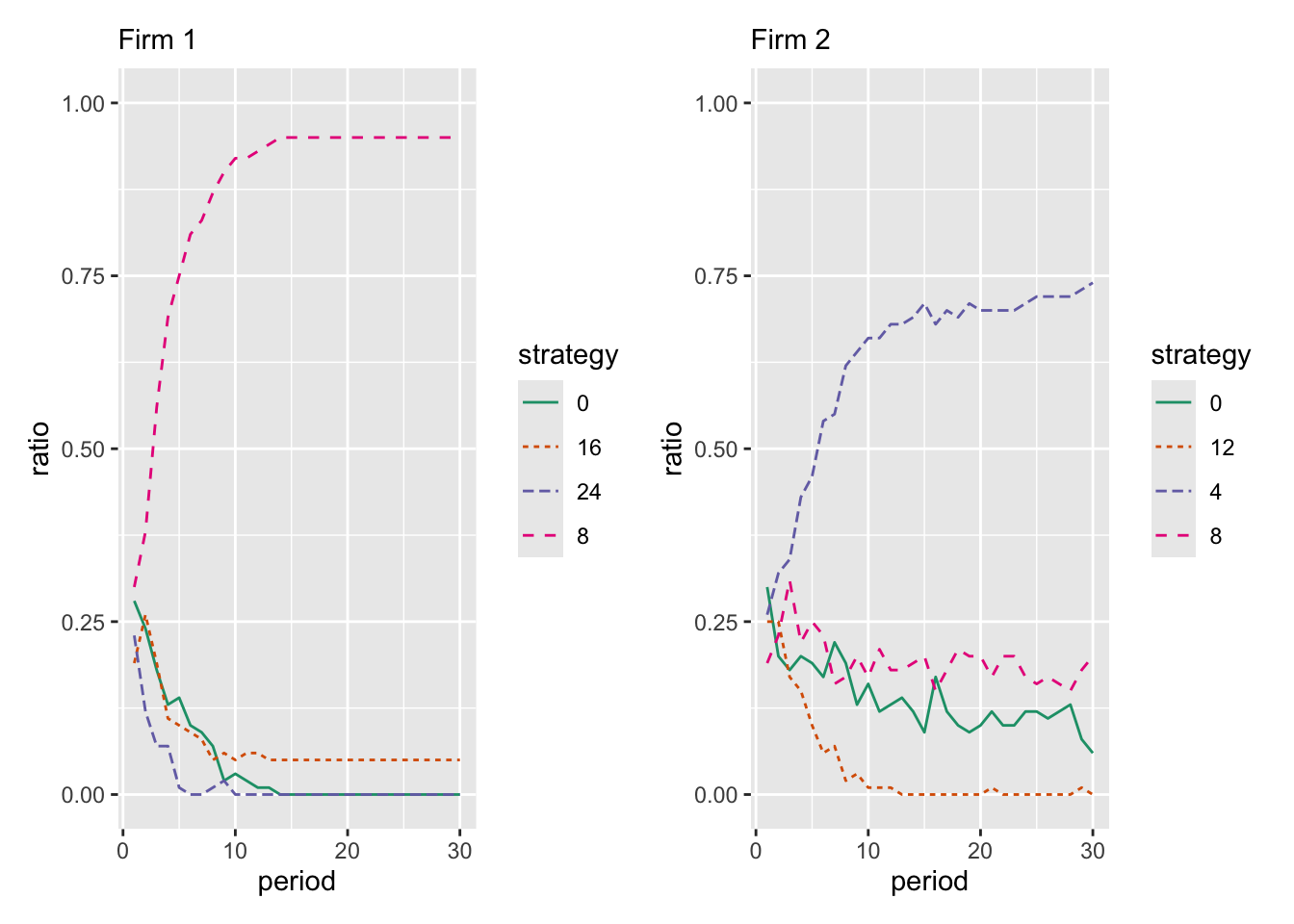
Show the results.
g6_reinf$plot_mean